Frequently Asked Questions
Open a section accordion first, then expand individual questions inside that section. Each section, including Section A and Section B, is now presented as a professional accordion panel.
The Youth Career Accelerator in Health is a 5-day immersive international workshop in Geneva, Switzerland, designed to help students and young professionals explore future-facing careers in health. The programme combines expert-led learning, career pathway exploration, real-world exposure, site visits, peer collaboration, and post-workshop career support.
The workshop will take place from 17-21 August 2026 in Geneva, Switzerland.
Venue Information
| Venue | Palais des Nations, 14 Avenue de la Paix, 1211 Genève 10, Switzerland |
|---|---|
| Building / Floor | Room III, Building A, 1st Floor |
| Visitor Entry | Attendees and visitors must access the campus through the Pregny Gate, located in front of the ICRC building. |
Geneva is a major hub for global health, diplomacy, international cooperation, and policy dialogue. It is home to leading UN agencies, global health institutions, NGOs, diplomatic missions, and international organizations, making it an ideal setting for participants to understand how global health decisions, partnerships, and careers are shaped.
The workshop is designed for students and early-career professionals who are studying, exploring, or considering careers in health and who are passionate about making an impact in people’s lives.
No. The workshop is open to participants from diverse academic and professional backgrounds. It is particularly relevant for those interested in public health, global health, medicine, pharmacy, life sciences, biotechnology, digital health, health policy, innovation, international organizations, NGOs, development agencies and health leadership.
The workshop goes beyond lectures. It is structured as an immersive experience combining technical sessions, site visits, career readiness activities, mentorship, group challenges, reflection circles, and networking. The format is designed to help participants connect learning with real-world exposure and practical career planning.
Participants will explore how the health sector is changing due to digital technologies, AI, climate change, funding shifts, global health challenges, public health transformation, and life-sciences innovation. They will also learn how to connect their interests and skills to practical career pathways in health.
The workshop focuses on four core career tracks:
- Global Health, Climate Health & Health Diplomacy: global health governance, international development, donors, NGOs, health equity, climate-health linkages and diplomacy.
- Public Health Systems, Policy & Healthcare Delivery: public health systems, healthcare delivery, policy, implementation, health workforce pathways and health systems roles.
- Digital Health, AI & Health Innovation: digital health transformation, AI for health, health data, health tech, entrepreneurship, innovation and digital governance.
- Pharmaceutical, Vaccine, Biotech & MedTech Careers: life-sciences careers across pharma, vaccines, biotech, MedTech, access, procurement, regulatory affairs, quality, manufacturing, supply chain and medical affairs.
The programme is structured in three stages:
- Before the workshop: online preparation sessions introduce participants to the programme, global health career trends, the four career tracks, CV and LinkedIn preparation, and the challenge bootcamp.
- During the workshop: participants take part in a 5-day Geneva immersion with technical sessions, expert discussions, site visits, career skills sessions, group work, challenge bootcamp presentations and networking.
- After the workshop: participants continue with reflection, mentorship, CV and LinkedIn refinement, opportunity mapping, alumni engagement and career progress review.
Before arriving in Geneva, participants join virtual preparation sessions. These sessions help them understand the programme structure, explore the global health career landscape, choose career tracks, prepare their CV and LinkedIn direction, and begin forming teams for the challenge bootcamp.
Across the five days, participants will move from understanding the health ecosystem to building a practical career plan. The agenda includes orientation, Geneva ecosystem exposure, technical sessions, career readiness workshops, site visits, challenge sprints, mentorship, vertical-specific masterclasses, career pathway breakouts, final presentations and closing reflections. For day-wise topics, participants should refer to the official agenda.
Yes. Site visits are a key part of the workshop. Depending on the final schedule, exposure may include UN agencies, diplomatic missions, donors, global health institutions, Swiss public health organizations, hospitals, universities, academic institutions, digital health labs, innovation hubs, pharmaceutical companies, biotech firms, MedTech organizations or life-sciences incubators.
Participants will learn from a diverse group of leaders and practitioners, including UN officials, global health leaders, public health experts, policymakers, industry professionals, innovation pioneers, academics, researchers and youth leaders.
Participants are expected to develop practical career and learning outputs, including a career reflection, primary and secondary track selection, updated CV direction, LinkedIn profile direction, short professional bio, group challenge output, site visit reflections, opportunity map, networking plan and personal 90-day career action plan.
Yes. Participants will take part in a challenge bootcamp. They may work on formats such as a presentation, policy note, innovation concept, poster, short video or other applied output linked to a real health challenge or career pathway theme.
The group challenge is an applied learning activity where participants work individually or in teams around a real health theme. Outputs may take the form of a presentation, poster, policy note, short video, innovation concept or career opportunity map. This mirrors real-world challenge formats used in career accelerator and leadership programmes.
The programme is designed to help participants understand the health sector before choosing a specific path. Through technical sessions, expert insights, site visits, mentorship and reflection, participants can compare different career options and identify roles, skills, institutions and entry routes aligned with their interests.
After the workshop, participants continue with virtual sessions focused on reflection, career action plan submission, CV and LinkedIn refinement, applications, UN and international organization pathways, mentorship circles by career track, opportunity mapping, networking, alumni showcase and continued community engagement.
Participants will join a diverse global cohort of future health leaders. The workshop creates opportunities to connect with peers, collaborate across backgrounds, build an international professional network, exchange ideas and continue engaging through the post-workshop alumni and mentorship pathway.
Yes. Participants who successfully complete the workshop requirements are expected to receive a certificate of participation, subject to attendance, engagement and programme completion criteria.
To make the most of the week, participants are encouraged to review their chosen health career track and areas of interest, prepare a short personal introduction, bring questions for speakers and site visit hosts, and update their LinkedIn profile and CV.
Participants should come ready to engage actively with peers from diverse professional and cultural backgrounds. Geneva offers a unique opportunity to gain exposure to international organizations, health institutions, diplomacy, innovation, and global health careers, so curiosity and active participation will be valuable.
Should I bring business cards?Business cards are optional. Participants who already have them may bring a few for networking. Alternatively, participants may share LinkedIn profiles or professional contact details digitally.
How can I prepare for networking sessions?Participants may prepare a brief 30-second introduction covering their name, country, academic or professional background, career interests, and what they hope to learn from the workshop. Updating LinkedIn and preparing thoughtful questions for speakers can also help participants make stronger professional connections.
Will participants work on assignments or career planning exercises?Yes. The workshop may include reflection activities, career planning exercises, workbook activities, group discussions, and assignments linked to the learning journey. A laptop or tablet will be useful for completing these activities.
To register for the workshop, click the "Register" button on the event website. Complete the registration form and follow the prompts to submit your details and confirm your interest.
The registration form may request basic personal details, contact information, academic or professional background, current institution or organization, country of residence, career interests, preferred career track, motivation for joining, accessibility or support requirements, consent preferences and emergency contact details where required.
No. Submission of the registration form records your interest or application. Your seat is confirmed only after the organizing team reviews the registration, confirms eligibility and availability, and receives the required participation fee or approved sponsorship confirmation, where applicable.
Yes. Because seats are limited, registrations may be reviewed based on eligibility, motivation, fit with the workshop objectives, background, diversity of cohort, payment status and seat availability.
Yes. Universities, academic institutions, student associations, public health associations, NGOs, employers and partner organizations may nominate suitable participants. Nominated participants must still complete the required registration process and meet the programme criteria.
Participants should contact the organizing team as soon as possible if any registration details need to be corrected or updated. Changes may be accepted depending on the nature of the update, operational timelines and programme requirements.
After submission, the organizing team may review your information, contact you for clarifications if needed, share payment or confirmation instructions, and provide next steps related to workshop preparation, logistics and onboarding.
Yes. Seats are limited to maintain the quality of interaction, mentoring, site exposure, group work and participant support. Early registration is encouraged.
The workshop will be conducted in English. Participants should have sufficient English proficiency to engage in discussions, group activities, presentations and networking sessions.
The workshop participation fee is CHF 950 per participant.
The CHF 950 workshop fee includes the official learning and participation components listed below:
- Pre-workshop, during-workshop and post-workshop activities
- Access to the 5-day workshop programme in Geneva
- Learning materials
- Lunch during the workshop days, as per the official programme
- Tea and coffee breaks during the workshop days, as per the official programme
- Planned site visit on Day 4, subject to final confirmation and institutional permissions
- Certificate of participation, subject to completion requirements
- LMS portal access
- Welcome kit at the on-site registration desk
- Participant badge
- Access to the community of practice
To redeem your referral benefits, select the appropriate referral category from the dropdown menu and enter the referral code provided by your university, organization, or friend.
The following costs are not included in the CHF 950 workshop fee and must be arranged and paid by the participant unless separately sponsored or explicitly confirmed in writing:
- Two-way international or domestic travel
- Local transport outside the official programme
- Visa application fees and related costs
- Accommodation
- Travel, health and personal insurance
- Breakfasts and dinners
- SIM card, roaming, internet or personal communication expenses
- Personal expenses, shopping, laundry and optional activities
Yes. Participants should separately budget for variable and personal costs that may arise before or during travel.
- Bank charges, ATM fees, currency conversion fees and international transaction fees
- Healthcare expenses, emergencies, missed flights, airline penalties, rebooking fees or incidentals
- Additional transport, meals or personal purchases not listed in the official programme
The estimated additional cost will vary depending on the participant’s country of departure, travel route, accommodation choice and personal spending. The indicative estimates below are provided only for planning purposes and are not fixed programme charges.
Indicative additional cost per participant above the CHF 950 workshop fee
| Region | Indicative additional cost above workshop fee |
|---|---|
| Europe | Approximately CHF 1,000 |
| Asia | Approximately CHF 2,000-2,500 |
| Africa | Approximately CHF 2,000-2,500 |
| Americas | Approximately CHF 2,000-2,500 |
Payment deadlines, cancellation terms and refund conditions should be reviewed carefully before confirming participation. Any refund or cancellation request will be handled in line with the official Terms and Conditions communicated by the organizing team.
Refund requests received on or before 31 July 2026 may be considered for processing, subject to verification of the participant’s registration and payment details.
Refund requests received after 31 July 2026 may not be eligible for processing. This is because event-related commitments, including venue arrangements, programme logistics, participant coordination, learning materials, catering planning, site visit arrangements, administrative processing, and other operational costs may already have been confirmed by that date. Submission of a refund request does not automatically guarantee approval. All requests will be reviewed in line with the applicable policy and administrative requirements.
Scholarship or sponsorship opportunities may be available depending on partner support and available funding. Interested participants should follow the official instructions on the website or contact the organizing team for current information.
Yes. A university, employer, sponsor or partner may support a participant’s fee where agreed. The participant should ensure that payment and confirmation requirements are completed within the stated timelines.
Yes. Participants are responsible for checking and securing any visa or travel authorization required to enter Switzerland. The organizing team may provide supporting documents where applicable, but visa approval is solely at the discretion of the relevant authorities.
Where applicable and after registration confirmation, the organizing team may issue a participation confirmation or invitation-related document to support a visa application. This does not guarantee visa approval.
No. Accommodation is not included in the workshop fee unless separately confirmed in writing. Participants are responsible for arranging and paying for their own accommodation.
Local transport is not included except for any transport specifically arranged as part of the official programme. Participants should budget separately for airport transfers, daily commuting and personal travel within Geneva.
Participants are strongly advised to obtain appropriate travel and health insurance covering the full duration of travel and stay in Switzerland, including medical needs, accidents, emergencies, travel disruption, baggage loss and personal liability.
Lunch and tea/coffee breaks are included during workshop days as per the official programme. Breakfasts, dinners, meals outside programme hours and personal dietary purchases are not included.
The organizing team aims to support inclusive participation where reasonably possible. Participants with accessibility needs, mobility requirements, assistive technology needs, dietary restrictions or other support requirements should indicate this in the registration form or contact the organizing team as early as possible.
Yes. Participants may request reasonable adjustments during registration. The organizing team will review requests based on feasibility, venue capacity, partner-site requirements, safety considerations and available resources.
Accessibility at external site visits may vary depending on the host institution, security requirements, building access and operational constraints. The organizing team will try to provide advance information and support where possible.
Participants should bring valid travel documents, any required visa, personal identification, travel and health insurance details, suitable professional clothing, a laptop or small-sized tablet if needed, chargers, any required medications and any materials requested before the workshop.
Yes. Participants are expected to behave professionally, respectfully and responsibly throughout the programme. This includes respecting peers, speakers, mentors, partner institutions, host-site rules, confidentiality expectations, cultural diversity and safety instructions.
Participants are expected to attend the full programme. Absence from sessions may affect learning outcomes, group work, networking opportunities and eligibility for a certificate of participation.
Personal information collected through registration and programme participation will be used for workshop administration, eligibility review, communication, participant coordination, logistics, learning activities, reporting, analysis, programme improvement, certificates, community engagement and post-workshop support, in accordance with applicable data protection principles.
The organizing team may collect information such as name, contact details, country, institution, academic or professional background, career interests, motivation, preferred career tracks, payment or sponsorship status, dietary or accessibility needs, emergency contact details and communication preferences.
Participant data may be shared only where necessary for programme delivery, administration, reporting, partner coordination, site access, certification, payment processing, safeguarding, legal compliance or participant support. Data will not be sold to third parties.
Yes. Participants may receive emails or other communications related to registration, payment, onboarding, preparation sessions, workshop logistics, learning activities, certificates, post-workshop mentorship, alumni engagement and relevant career opportunities. Participants may manage communication preferences where applicable.
Photos, videos, testimonials or participant stories may be captured during the workshop for documentation, reporting, communication or promotional purposes. Where required, consent will be sought, and participants may contact the organizing team if they have concerns about media use.
Participants may contact the organizing team to request access to, correction of or deletion of their personal data, subject to applicable legal, contractual, administrative and programme record-keeping requirements.
Participant data will be retained only for as long as necessary for the purposes for which it was collected, including programme administration, reporting, certification, audit, legal, safeguarding and alumni engagement purposes, unless a longer retention period is required or permitted by law.
The workshop website may use essential cookies, analytics or similar technologies to operate the website, improve user experience and understand engagement. Where required, cookie notices, consent options or privacy information should be provided on the website.
Participants can contact the organizing team using the official email address listed on the website for questions about privacy, consent, communications or data-related requests.
To learn about sponsorship opportunities, email partnerships@empowerswiss.org. Sponsors may support scholarships, participant access, learning activities, expert engagement, networking, communication or broader programme delivery.
Yes. Universities, academic institutions, student associations, public health associations, NGOs, foundations, development organizations, hospitals, healthcare organizations, innovation hubs, pharmaceutical, biotech, MedTech and digital health organizations may collaborate in different ways depending on alignment and capacity.
Partners may support participant outreach, nominations, speakers, mentors, site visits, exposure sessions, scholarships, sponsorships, institutional visibility, technical expertise, challenge themes or post-workshop career support.
Yes. Partner institutions may nominate suitable students or young professionals. Nominated participants must still complete the registration process and meet the programme criteria.
Depending on the scope of collaboration, partners may receive visibility through the website, brochure, communication materials, social media, event acknowledgements, session materials or certificates, subject to agreed branding and approval guidelines.
A formal agreement, MoU, letter of collaboration or sponsorship agreement may be required depending on the nature of the collaboration, use of logos, funding, data sharing, speaker participation, site visits or institutional commitments.
Stay informed by following Empower School of Health on social media, subscribing to the newsletter and regularly visiting the event website for updates.
For any inquiries, participants and partners may contact the workshop officers listed below:
- Mr. Luca Wunderlich | Project Officer | United Nations Institute for Training and Research (UNITAR) | luca.wunderlich@unitar.org
- Dr. Shyamli Thakur | Coordinator - Projects & Partnerships | Empower School of Health, Geneva | partnerships@empowerswiss.org
- Mr. Daniel Nazarov | Senior Program Coordinator | United Nations Institute for Training and Research (UNITAR) | daniel.nazarov@unitar.org
Yes. Participants should refer to the Geneva Workshop Agenda & Schedule available on the YCAH website for an overview of the workshop schedule, key milestones, and important dates.
The final programme agenda will be shared prior to the start of the workshop and will include daily start and finish times, session schedules, speaker information, site visit details, meeting locations, and any programme-specific instructions.
The workshop includes expert-led sessions, practical learning activities, career development workshops, and institutional or site visits across Geneva's global health ecosystem.
Do we need to bring printed documents, confirmation emails, participant materials, or the workbook?Printed materials are generally not required. Participants are encouraged to keep digital copies of important documents easily accessible on their phone, laptop, tablet, or cloud storage.
- Registration confirmation
- Travel itinerary
- Accommodation details
- Passport identification page
- Visa-related documentation, where applicable
Programme resources, workbooks, schedules, and supplementary materials will either be shared digitally before or during the programme.
What travel and identity documents should I keep available?Participants should keep their passport or national identity document used for travel readily available, especially for registration, venue entry, and any institutional or site visits.
Please ensure that the identification document you bring matches the details submitted during registration. This is particularly important for security processing and visitor badge issuance at official venues.
In addition to the passport or national identity document used for travel, participants are advised to bring practical items that support learning, mobility, and networking during the week.
- Laptop or small-sized tablet for notes, workbook activities, and assignments
- Notepad and pen for personal notes and reflections
- Reusable water bottle
- Any personal medication you may require
- Business cards, if available, for networking
- Comfortable walking shoes for site visits and movement between buildings or public transport
Should I bring a laptop or tablet?
Yes. A laptop or small-sized tablet is recommended for reviewing programme materials, taking notes in the digital workbook, completing career planning exercises or assignments, and accessing online resources during breaks.
Participants who prefer handwritten notes may also bring a notebook, but a digital device will be helpful throughout the programme.
Do I need a plug adapter, charger, or power bank?Participants should bring chargers for their devices and consider carrying a portable power bank. International participants should also bring a suitable travel adapter compatible with Swiss power sockets if needed.
Power access may be limited during certain sessions or site visits, so participants should arrive with devices charged each day.
Should I carry personal medication or health items?Yes. Participants should carry any personal medication they require, along with prescriptions or supporting documentation where relevant. The organizers are not able to provide personal medication or specialized medical supplies.
Business casual is appropriate throughout the week and is strongly recommended. For sessions at the Palais des Nations and visits to international organizations, participants are encouraged to dress professionally and comfortably.
- Shirts, blouses, polos, or smart tops
- Trousers, chinos, skirts, or business-casual dresses
- Closed shoes or smart casual footwear
Formal business attire is not required, although participants may choose to wear it for networking opportunities or formal sessions.
What should I keep in mind for professional etiquette?Participants are expected to be punctual, respectful, and actively engaged during sessions, site visits, and networking activities. Mobile phones should be kept silent during formal sessions, and photography should only be taken where permitted by the venue or host organization.
A detailed agenda with arrival instructions will be shared before the programme begins. Based on standard Palais des Nations procedures, participants should plan to arrive at least 30 to 45 minutes before the start of the first session to allow time for security screening and registration.
Visitors should expect identity verification, security screening similar to airport-style checks, and presentation of a valid passport or accepted government-issued identification.
Please ensure that the identification document you bring matches the details submitted during registration.
Will participant badges or UN access passes be provided in advance?Participant access credentials and visitor badges are normally arranged through the programme organizers. For events held at the Palais des Nations, badges are typically issued upon arrival after identity verification and security processing.
Important: UN Palais / Indico Pre-RegistrationParticipants are required to complete an online pre-registration step for access to the UN Palais des Nations.
- Create an indico account.
- Register for the event via the YCAH specific link: https://indico.un.org/event/1025410
- Please refer to this link how to create an Indico account: Create an Indico.UN account | Indico.UN Help
- Please refer to this link of how to register for the event: Register to an event | Indico.UN Help
- (Do this well in advance. Security clearance is not instant and might take a day or two)
- Wait to be verified for the event via email.
- Check if you have received the digital badge. (Reference image attached)
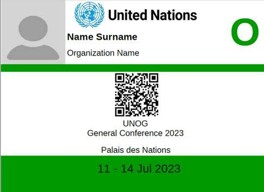
Digital Badge Reference
Check if you have received the digital badge.
(Reference image attached)
- Get your digital badge verified and activated at Pregny Gate.
- You will only be able to get your pass verified at Pregny Gate.
- Please make sure to bring a valid passport or national ID with a name that matches exactly the one you used to register on Indico. Participants who are unable to provide matching identification will unfortunately not be able to gain entry at the gate.
- Please allow ample time the first day as the line to get verified can be quite long. We recommend arriving at least an hour before.
- You will have to stand in line to grab a number from the ticket machine at the entrance right after the revolving doors. Your number will then be called and displayed on a screen. Please go to the counter announced to verify your badge.
- Please make sure to have everything ready before going to the counter: Passport or ID, and the digital badge that you will have received via email after registering on indico and being verified.
- Once the digital badge is activated it will be valid for the duration of the event and you can skip the line
Entrée des visiteurs
Palais des Nations - Porte de Pregny
14 Avenue de la Paix
1211 Genève, Suisse
No. Access to official venues and programme activities is limited to registered and approved participants, speakers, organizers, and authorized guests. Participants should not bring accompanying visitors unless this has been expressly approved by the organizing team in advance.
Conduct at the Palais des NationsThe Palais des Nations is a working diplomatic environment. Meetings, negotiations, and delegations from across the world are taking place around us throughout the week, and our presence there is a privilege extended by the host. A few points to keep in mind:
- Photography: Photography is generally permitted in the building and grounds. Please be mindful, however, not to photograph other people without their consent, including delegates, staff, etc. Some meetings and areas may be restricted, and where signage or staff indicate that photography is not allowed, please follow those instructions.
- Circulation: Please keep corridors, doorways, and stairwells clear at all times. When gathering in groups between sessions, move to the side so that others can pass freely, and take particular care not to obstruct emergency exits.
- Respect and representation: Delegations and staff from nations around the world work in this building every day. As participants in a programme co-hosted by UNITAR, you are also representing your own countries, institutions, and this programme. We ask you to conduct yourselves accordingly: keep noise to a minimum in shared spaces, be courteous to everyone you encounter, and treat all colleagues with respect, whatever their background or views.
Please inform the organizing team as early as possible if there is any change to the name, passport number, identification document, or other details submitted during registration. Updated information may be required for security and access processing.
Lunch vouchers will be provided during programme activities for all five days. Participants should plan separately for breakfast, refreshments (tea/coffee), dinner, and any personal food or beverage needs.
Can dietary requirements be accommodated?Lunch vouchers will offer participants the flexibility to select meals that accommodate their dietary restrictions, allergies, or specific food requirements.
Should I bring snacks or a water bottle?Participants may bring a reusable water bottle and light personal snacks, especially for longer days or site visits. Please follow venue-specific rules regarding food and beverages.
- In Geneva, unireso public-transport tickets must be purchased prior to boarding a tram, bus or ferry. Ticket machines are available at most stops. Travel cards or passes can be purchased at the main TPG centres (Rive, Cornavin and Bachet de Pesay).
- Please note tickets are not available on the bus itself. Hotels, youth hostels or campsites typically offer a Geneva Transport Card, which allows use of public transport in Geneva free of charge during the period of stay.
- Ongoing roadworks around the Palais des Nations affect car access and public transport. Please allow extra travel time.
Geneva Workshop address: Room III, Building A, 1st Floor, Palais des Nations, 14 Avenue de la Paix, 1211 Geneva 10, Switzerland
Access: Through Door A11
Directions for Building A, Room III- After entering through Pregny Gate, continue straight. Pass over the two consecutive yellow pedestrian crossing.
- Turn right and walk alongside the building.
- Take the stairs to your left, pass in front of door A13 and turn right on the sidewalk.
- Enter through door A11 on your left. (If the door is not open, you will have to enter the building in single-file through he revolving door. To do so you will have to scan the QR code you find on your digital badge with the scanner mounted to the right side of the door. Small tip: Don't zoom into the QR code and keep it the same size as displayed, as a bigger QR code might not scan properly. Also keep the brightness of your device at a maximum when scanning)
- Once inside the building, turn left. You will find room 15 on your right. For rooms 3 take staircase 11, which is on your left and go down one floor.
- Exiting the staircase, you will find room 5 to your right and room 3 further down also to your right.
Public Transport Geneva: Palais des Nations transit stops are Appia and Nations.
Access from Cornavin railway stations- Bus lines 5, 8, 20, 60 ("Appia" stop)
- Tram line 15 (“Nations” stop), then a 5 minutes' walk to Pregny Gate
- Bus line 5 (“Appia” stop)
Other bus lines with stop at “Nations”: Other bus lines with stop at “Nations”: 11 and 22, then a 5 minutes' walk to Pregny Gate.
Site visit 1 (Global Health Campus) address: Chemin du Pommier 40, 1218 Le Grand-Saconnex, Switzerland
Bus options: 5, 22, 28, FSite visit 2 (Referens Clinic and Campus Santé La Tour Innovation) address: Chemin de la Planche 1, 1217 Meyrin, Geneva, Switzerland
Bus options: 18, 57, 67, 68, 71, A3Participants are expected to travel independently to the event venue and site visit locations, either by using Geneva’s safe and efficient public transport network or, where practical, by walking. Clear directions, meeting points, and relevant public transport information have been shared to support participants in planning their journeys.
Depending on the programme schedule and destination, participants may be asked to travel individually, in small groups, or together with programme staff.
Will meeting points, timings, and logistical details be shared beforehand?Yes. Participants will receive final logistical information before the programme commences and daily updates during the week as needed.
- Daily schedules
- Meeting locations
- Site visit timings
- Contact information for programme coordination
Yes. Some programme activities and site visits may involve walking between buildings, moving through security areas, or using public transport. Comfortable walking shoes are recommended.
Daily updates may be shared through email, the participant communication group (WhatsApp), the LMS or website portal, or in-person announcements during the programme. Participants should check official communication channels regularly throughout the week.
What happens if there is a change in timing, speaker, or site visit schedule?The programme team will communicate any changes as early as possible. Because international programmes may involve external institutions, speakers, and security procedures, some adjustments to timing, access, or session order may occasionally be required.
Who should I contact during the workshop for logistical support?For any inquiries, participants may contact the workshop officers listed below:
- Mr. Luca Wunderlich | Project Officer | United Nations Institute for Training and Research (UNITAR) | luca.wunderlich@unitar.org
- Dr. Shyamli Thakur | Coordinator - Projects & Partnerships | Empower School of Health, Geneva | partnerships@empowerswiss.org
- Ankit Kaushik | Senior Program Lead – Youth Career Accelerator in Health | Empower School of Health, Geneva | Assoc.dir1@empowerschoolofhealth.org
Internet access may be available at some venues, but availability can vary by location and host institution. Participants should not rely solely on venue Wi-Fi and may wish to arrange mobile data or an international roaming plan for essential communication.
What should I do if I have accessibility requirements?Participants with accessibility requirements should inform the organizing team as early as possible. The team will make reasonable efforts to support accessibility planning, subject to venue arrangements, site visit requirements, and local availability.
What should I do in case of illness or emergency during the programme?Participants should immediately inform the programme coordination team if they feel unwell or need urgent assistance. International participants are strongly encouraged to have suitable travel and health insurance covering the full duration of their stay in Switzerland.
Is attendance required for all sessions?Participants are expected to attend all scheduled sessions, site visits, and programme activities unless they have a valid reason and have informed the organizing team. Attendance may be considered for certificate eligibility and programme completion records.
Will participants receive a certificate?Participants who successfully complete the workshop requirements are expected to receive a certificate of participation, subject to attendance, engagement, and completion criteria communicated by the organizers.
Can participants take photos or record sessions?Photography or recording may be restricted in certain venues, sessions, or site visits. Participants should follow instructions from the organizers and host institutions before taking photos, videos, or recordings.